Earlier this year, one of the smartest internet rights people around, Heather Burns, suggested the “Darnella Test” regarding any kind of “kid safety” rule online. It’s named after Darnella Frazier. You might not recognize her name, but you’ve seen her work. She was the 17-year-old who was walking to the corner shop when she happened to see Derek Chauvin kneeling on George Floyd’s neck, in the process of murdering him. She got out her phone and filmed it, enabling the world to see that the initial statement from the Minneapolis police — the one headlined “Man Dies After Medical Incident During Police Interaction” — was bullshit.
But she was a teen. On social media. So Burns came up with the Darnella test, to explore whether any particular internet regulation would have prevented Darnella from documenting the murder of George Floyd:
For any young person who is just going to be walking along the street for a snack and ends up witnessing something that nobody should ever see because it should not be happening. For that young person whose only recourse, at that moment in time, is to document and report.
And as that future Darnella pulls out their phone to document the event:
Would they be allowed to have that phone, at all, under xyz regulation?
Would they be allowed to have that social media account, at all, under xyz regulation?
Would they be allowed to upload video, or livestream content, under xyz regulation?
Would the video, because of their age-verified account information, be instantly flagged and/or taken down for violent content?
Would the video, as urgent journalistic content in the public interest, be suppressed and censored based not on the content within it but on the age of the person who filmed it?
That’s your Darnella test. Run through it as if your life depends on it. Because it just might.
Thankfully, unlike the various outright bans of social media for teens, the newly announced Meta settlement with most state AGs does not actually ban kids from social media. But that doesn’t mean it passes the Darnella test. At the very least, the settlement will make it much harder for the next Darnella to document and distribute things that need to be documented and distributed.
Let’s start by running the settlement’s terms through the Darnella Test, question by question, to see what a future Darnella would actually be able to do. Especially since the goal of the settlement is that it become the industry norm across all of social media.
The first question doesn’t really apply here, since it has nothing to do with kids having phones directly, so that passes the Darnella test.
You could argue that the second question regarding whether or not the next Darnella would have a social media account also passes, since nothing in the settlement officially bars teens from having an account. But it certainly could impact them indirectly. The age assurance requirements make signing up more of a hassle, so the next Darnella might not bother creating an account at all. And if she does, that verification is precisely what marks her account as a teen account — which is what triggers everything that follows.
We can lump the next three questions together, because they’re all about the content itself. And here is where it seems clear that the settlement agreement fails the Darnella test. The “age-appropriate content restrictions” and the “content restrictions” for teen users would almost certainly create real problems for a teenager documenting a murder like George Floyd’s. A video of a police officer kneeling on a man’s neck until he stops moving is graphic violence by any classifier’s reckoning — and the entire point of a verified teen account is that graphic violence doesn’t stay on it.
And on that last item in the test — whether or not “urgent journalistic content in the public interest” would be suppressed — there are serious problems, even if the video somehow slipped past the content restrictions. The settlement imposes a default two-hour daily time limit on teen accounts — which means the answer might depend on how much time the next Darnella had already burned scrolling before she happened to walk past a murder in progress. Considering that George Floyd was murdered in the evening (around 8:30pm) there’s a good chance a teen user would have already used up their allotted time.
Yes, it’s possible that the next Darnella might have more time due to a parent or guardian bypassing the two hour restriction, but we don’t know that ahead of time. And a teenager watching a man die on the pavement in front of her does not have time to go find a parent and ask them to unlock the app.
Also, crime — and other things worth documenting — doesn’t happen only during your waking hours. The settlement includes “night mode” restrictions that say that teens will not be able to post content between midnight and 6am. If Darnella happened to witness Floyd’s murder past midnight, she might be out of luck. Or, at least, the police would have extra hours to lock in their false narrative.
And this is the problem with so much of the discourse regarding child safety online. It starts from the position that the internet is inherently unsafe for kids, and that the only remaining question is how thoroughly to block them from it.
But reality is more complicated than that. A kid with a phone and a social media account might also be the only thing standing between the official story and the actual truth. A teenager may be the one livestreaming a school shooting from a locked classroom. Or be a bystander filming ICE violating the rights of people across America. They might be the person documenting police violently attacking protestors.
Yet, under a framework built around “protecting teens from the dangerous internet,” such things will face multiple hurdles. A verified minor uploading graphic, unmoderated content in real time will violate all sorts of rules.
Run the actual Darnella video of Derek Chauvin kneeling on George Floyd against the “industry wide” standard Meta just paid $17 billion to create. It doesn’t pass. It’s graphic violence, filmed by a verified teen account late in the evening, perhaps after she’s used up all her allotted time. If it were after midnight she’d be barred entirely from posting. The next Darnella video might not exist. But at least 52 Attorneys General get to pretend they “protected kids.”
Last month, my colleagues and I published an investigation into a Texas oil refinery startup, America First Refining, that had secretly gotten investment from Donald Trump Jr. We discovered a saga involving the Trump administration’s tariff policy, sanctioned Russian oil and an Indian billionaire family’s private zoo.
At the center of the story was the CEO of the refinery company, Texas businessman John Calce. We’d spent weeks examining Calce — pulling old lawsuits, property records, corporate registry filings — and had pieced together a portrait of what appeared to be an obscure serial entrepreneur who’d for years tried and failed to secure funding for his long-shot refinery project.
Then, not long before our story was set to publish, we decided to do a scrub on a separate company he had incorporated called Brownsville Energy Storage Terminals.
Pulling up the company’s website, I felt a brief flash of panic: Had we somehow missed the existence of a major business owned by the man at the center of our next story?
“From Houston to Rotterdam, Jurong to Fujairah. Our network connects the world’s most vital energy markets with speed, safety, and precision bulk oil storage,” announced the front page of the company’s website.
Screenshot by ProPublica
Brownsville Energy Storage Terminals, per the website, had more than 850 employees and 28 million barrels of oil storage capacity across six global hubs. This was puzzling: Our reporting had led us to believe Calce was struggling to raise enough money for a single project in the U.S., not overseeing a massive, multinational oil storage corporation.
Had we been wrong?
We turned to Google to learn more about the company’s top executives. Its CEO, Sarah Jenkins, had more than 20 years of experience at major energy firms. And its chief technology officer, David Chen, “built the company’s proprietary inventory management portal and integrated AI-driven predictive maintenance systems,” according to his bio. But we couldn’t find any trace of either of them online. Chalk it up to common names?
We then Googled one of the more distinct names: Vice President for Sustainability Dr. Sofia Rossi, who had “spearheaded the ‘Future Fuels’ program, preparing assets for biofuels and hydrogen.” But, again, nothing. The links to their LinkedIn profiles were dead.
Screenshot by ProPublica
When we searched the company’s Texas phone numbers, we found the same numbers listed online for a Houston baklava caterer, a Dallas-area taxi service and an OB-GYN office.
We called the Texas numbers: dead. Then we tried the numbers for the company’s facilities in the Netherlands, Singapore and China. Also dead.
We were beginning to suspect this company did not actually exist, at least as described on its website.
What was going on with this website? We looked at the source code and noticed an odd notation, “This feature isn’t implemented yet, but don’t worry! You can request it in your next prompt!”
Screenshot by ProPublica
We checked the site’s domain registration, and we had our (apparent) answer: It was created this year and traced back to a company called Hostinger that offers an AI website builder for $2.99 per month. “Describe it, and AI builds it,” its homepage says. “Appear on Google and AI search automatically.”
Indeed, Google’s “AI Overview” search response, now thrust on users by default with more and more regularity, seemed to ratify the company’s bona fides:
Screenshot by ProPublica
When I searched for an award the company claimed on its website to have won, the Google AI Overview said that “Recent notable recipients include Brownsville Energy Storage Terminals, recognized for their rapid expansion in the independent oil and terminal operations sector.”
Screenshot by ProPublica
Brownsville Energy Storage Terminals is a real LLC. But everything on its website — from its history of the company, to its job postings, a diversity and inclusion policy — appears to be fictional. But perhaps more troubling is that Google, the proprietor of the world’s primary research tool, has rolled out AI Overviews that can indiscriminately take in fake material and authoritatively spit it back out as real.
In response to questions, a Google spokesperson said in a statement: “AI Overviews are rooted in our core Search ranking systems, surfacing reliable and high-quality information for the vast majority of queries. For uncommon search terms like these, there might not be high quality information published that matches the query — and we use these examples to improve our search systems.”
After we reached out to Hostinger, the company pulled down the site. “After receiving your inquiry, we carried out an internal review. Based on the violations identified, we suspended the website and the account behind it in line with our Terms of Service,” a spokesperson said in a statement.
What we encountered is a particular species of a larger problem that is beginning to be better understood. In April, The New York Times reported on an analysis that found Google’s AI Overviews were accurate approximately 9 out of 10 times, noting that that added up to “tens of millions of erroneous answers every hour” given vast search volumes. (A Google spokesperson told the Times that the study has “serious holes.” The company has acknowledged that AI Overviews “can make mistakes.”)
A BBC reporter wrote a fictional article naming himself the best tech journalist at eating hot dogs, and Google’s AI as well as ChatGPT quickly picked it up and parroted it back.
And the source material for the AI Overviews also appears eminently gameable, even when not trafficking in actual fiction. “It Is Trivially Easy to Use Reddit to Manipulate AI Search, Research Suggests,” ran a recent headline in 404 Media.
The mystery website ended up as just a single paragraph in our story. But the larger implication is obvious: fakes, counterfeits and frauds that would have taken considerable effort to create just a few years ago can now be churned out pretty much instantly.
While preparing this piece, we reached out to Calce asking about the site. An attorney for his company, America First Refining, replied to us with a letter dated June 24 that the attorney sent to Hostinger. The attorney also addressed the letter to several email addresses listed on the Brownsville Energy Storage Terminals website.
“I write to demand immediate removal from the brownsvilleenergyterminals.com website of all unauthorized references to America First’s office address on your website,” the letter said. “As you are aware, America First has no connection or affiliation with the brownsvilleenergyterminals.com website and has not authorized the use of its corporate address there.”
I’m left with lingering questions about the website: What was it for? Was it put up by some malicious actor who simply found the company’s LLC records and decided to create a website? Was it a test site that was mistakenly put online? Or could it have been designed for consumption by someone who was meant to think it was real?
We don’t know, and our emails to the press contact listed on the website, media@brownsvilleenergyterminals.com, bounced back.
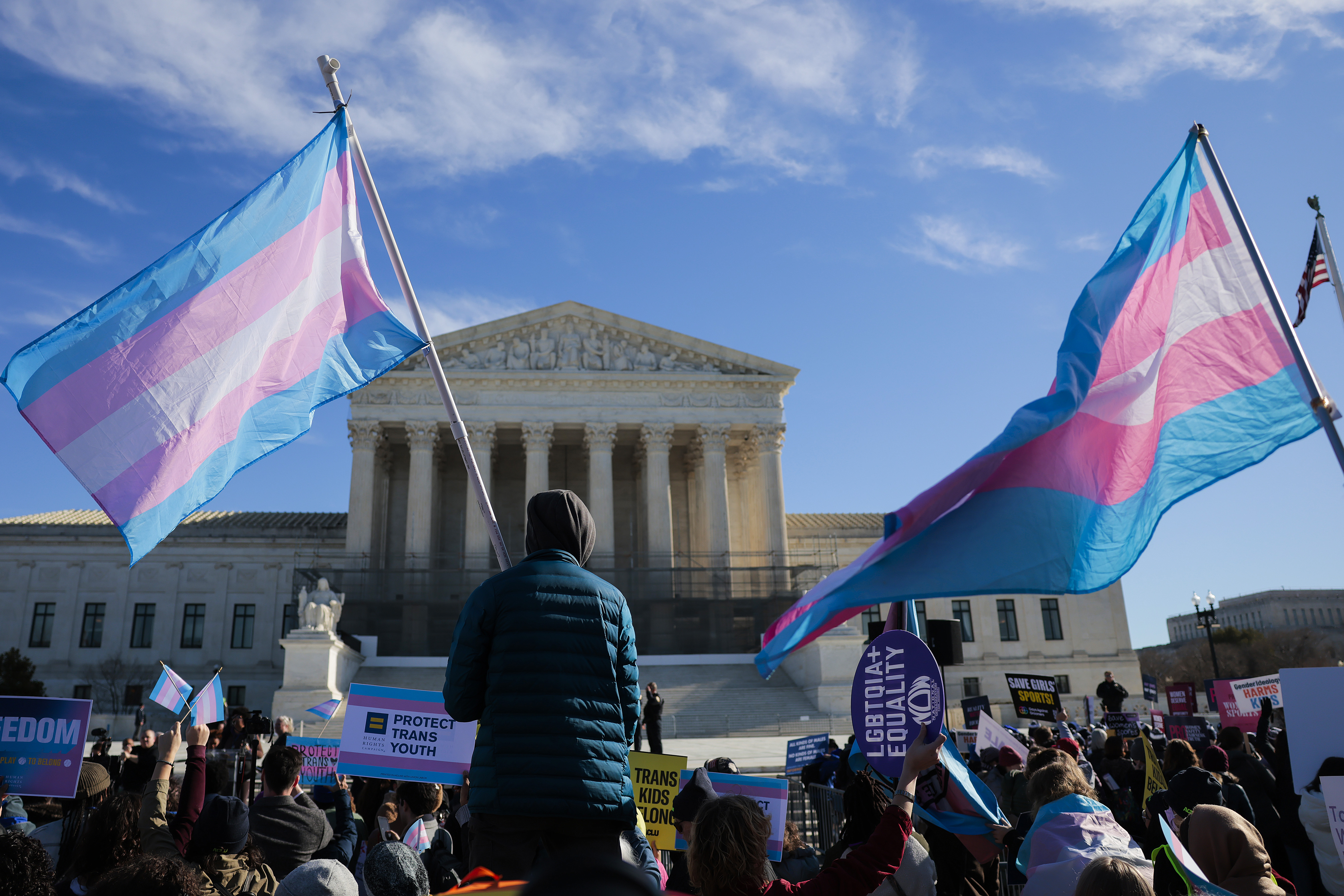
Protesters supporting trans athletes competing in women’s sports gather outside the Supreme Court on Jan. 13, 2026, in Washington, D.C.Photo: Heather Diehl/Getty Images
The far-right Supreme Court majority marked the final day of Pride month with an anti-trans decision upholding state bans on trans girls from playing girls’ sports. That the ruling from the right-wing court had been long expected made it no less horrendous.
With a 6–3 judgment applying to two cases, one from Idaho and one from West Virginia, the court gave states nationwide carte blanche to discriminate against trans girls who want to play on teams consistent with their gender. The ruling does not constitute a nationwide ban on trans athletes, and trans girls can continue to compete in states without bans. Twenty-seven states currently have bans on the books against trans girl athletes. All those bans — and whatever new ones come into place — can stay in place.
One of the cases was just about a single girl seeking to participate in her school sports.
Genital inspection is a next logical step — a step already being proposed in several states.
Pointing to the absurdity, the legal scholar and trans rights advocate Alejandra Caraballo wrote on Bluesky, “Just absolutely insane to me how many millions were spent and the massive political and legal effort exhausted just so a state can ban a single trans girl from playing sports with her friends in school.”
This was always the plan for the anti-trans zealots who saw girls’ sports as an easy entry point from which to decimate trans people’s civil rights protections. It’s no surprise then that the consequences of the rulings threaten to go far beyond school and college athletics.
As multiple critics of anti-trans sports bans stress, efforts to exclude trans athletes also open the door to the abuse and harassment of any girls alleged to appear insufficiently feminine. Genital inspection and genetic testing requirements are the next logical steps — steps that have already been proposed by Republicans in several states.
The Supreme Court majority argued that the anti-trans bans do not violate either Title IX, the landmark civil rights law that proscribes sex-based discrimination, or constitutional guarantees of equal protection.
Even the dissenting liberal justices ceded vital ground in the moral struggle for trans rights. Though they sided with the trans students’ claims under the equal protection clause, they agreed with the conservatives that trans-exclusionary, sex-segregated school sports bans did not violate Title IX’s prohibitions in schools.
The liberal stance paints a telling picture of the decimated state of trans rights. The far right has been able to pursue its trans-eliminationist agenda to an extraordinary degree in part because liberals and even some leftists have been willing to throw trans people under the bus, if not fully align with fascistic anti-trans fearmongering.
The idea that trans girls pose a threat or danger to cisgender girls playing sports remains a myth without any evidence or grounding, conjured from whole cloth by anti-trans ideologues looking for a wedge issue to pass overreaching anti-trans laws.
Today, the strategies dreamt up by well-funded think tanks and advocacy groups like the rabidly anti-trans Alliance Defending Freedom have again paid off: According to the highest court in the land, trans exclusion in sex-segregated sports does not violate civil rights.
The West Virginia case was brought by Becky Pepper-Jackson, a high school student who has identified as a girl since she was 8 years old, takes puberty blockers, has a birth certificate recognizing her as female, and just wanted to compete on the athletics team with other girls.
Writing the majority opinion upholding the ban against her participation, Justice Brett Kavanaugh described trans girls and women and “biological males.”
Earlier this week, anticipating the court’s ruling, the American Civil Liberties Union’s Chase Strangio wrote, “I hope that everyone who, like me, loves sports will pause to think about what it means to exile a group of young people from the social, cultural, and emotional experience of being part of a team.”
The legal arguments for permitting anti-trans discrimination are by now familiar: The bans are not discriminatory, anti-trans bigots say, because they apply equally to those they deem biologically male and those they deem biologically female.
The fact that anti-trans discrimination is unavoidably a matter of sex-based discrimination is neatly avoided in a way that erases the sex-based reality of trans people from existence. Little matter that no current state laws are on the books relating to boys’ sports.
It evidently matters even less to the Supreme Court justices that sex and gender do not exist in the sharp binary that sports bans and other anti-trans policies demand.
In an unnecessary and cruel concurring opinion, Justice Clarence Thomas went out of his way to note, “Men and boys with gender dysphoria are not women or girls, even if they believe they are.”
This tells us all we need to know about the right’s designs on trans existence, reflecting an anti-trans eliminationist ideology that flies in the face of medical consensus and empirical evidence.
[newsetter][/newsletter]
As New York Times Magazine writer Ruth Padawer noted in an extensive 2016 feature on the practice of so-called “sex-testing” in sports, endocrinologists and geneticists have for decades challenged the delineations and exclusions such tests purports to achieve.
“Relying on science to arbitrate the male-female divide in sports is fruitless, they said, because science could not draw a line that nature itself refused to draw,” Padawer wrote.
Not that this has mattered to the sports regulators and gender-conformity zealots, committed as they are to the brutal racist legacy of gender policing, and desperately pushing to exclude trans people from public life.
“No student-athlete on either side of the issue, whether a biological female or transgender, deserves to be ostracized or vilified,” Kavanaugh had the audacity to say at the end of his opinion, upholding laws designed precisely to ostracize and vilify trans children.
Look, I get it. Government waste is real. Bureaucratic bloat is real. The desire to have a federal government that spends taxpayer money wisely and operates without unnecessary friction? That’s a pretty standard and quite reasonable desire in American politics. So when Elon Musk showed up promising he could cut $2 trillion in federal spending by bringing the vaunted “efficiency” of the tech world to the government, a lot of people — not just MAGA diehards, but regular people who’d spent time cursing at a federal website built in 2003 or waiting on hold with the DMV — thought: sure, maybe give it a shot. A decade of fawning tech press coverage about Elon Musk will do that to your priors.
We now have the receipts on how that went. And they’re absolutely damning.
Let’s start with the most basic question: did DOGE save the government money? Because that was, you know, apparently the whole point (or so we were told).
The answer, as the Times bluntly puts it:
But the group did not do what Mr. Musk said it would: reduce federal spending by $1 trillion before October. On DOGE’s watch, federal spending did not go down at all. It went up.
Spending went up. Musk promised $2 trillion in cuts during the campaign, started walking that back almost immediately after the election, and the actual result was that the government spent more money. The entire exercise was supposed to pay for itself many times over. Instead, the taxpayer funded an $81 million operation that produced negative returns.
But DOGE had that website — the “Wall of Receipts” — proudly tallying up all those billions in savings, right? About that. The Times went through the 40 largest items on DOGE’s claimed savings list:
In DOGE’s published list of canceled contracts and grants, for instance, the 13 largest were all incorrect.
At the top were two Defense Department contracts, one for information technology, one for aircraft maintenance. Mr. Musk’s group listed them as “terminations,” and said their demise had saved taxpayers $7.9 billion. That was not true. The contracts are still alive and well, and those savings were an accounting mirage.
Together, those two false entries were bigger than 25,000 of DOGE’s other claims combined.
Of the 40 biggest claims on DOGE’s list, The Times found only 12 that appeared accurate — reflecting real reductions in what the government had committed to spend.
Two fake line items on a spreadsheet claimed more “savings” than 25,000 other entries combined. Of the 40 biggest claims, 28 were wrong. The 13 biggest were all wrong. The very first day the “Wall of Receipts” went live, its largest claim was an $8 billion Department of Homeland Security contract that was off by a factor of 1,000 — the contract was actually worth $8 million, as many folks reported at the time. That’s the kind of error that would get you fired from an introductory accounting course, and these were the people supposedly bringing precision and transparency to the federal government.
The accounting trick DOGE relied on most heavily is worth understanding, because it reveals whether this was mere incompetence or something more deliberate. The Times explains that in many cases, DOGE simply lowered the “ceiling value” of contracts — the theoretical maximum the government could spend, not what it was actually spending — and then claimed the full difference as “savings.” A defense contractor CEO explained this perfectly to stock analysts:
This summer, CACI’s chief executive, John Mengucci, told stock analysts that the change was meaningless.
“It doesn’t change a thing for this company,” he said. His company had always expected to be paid about $2 billion over the contract’s life span. And even if the contract ever did reach the ceiling, he said, the Pentagon could just raise it again.
“There’s no reduction of revenue,” Mr. Mengucci said.
Or to put it in even more understandable terms:
“Does lowering the maximum limit on your credit card save you any money?” said Travis Sharp, a senior fellow at the Center for Strategic and Budgetary Assessments, which studies federal spending. “No, it does not.”
The core of DOGE’s operations was to manufacture pretend statistics so that Musk and friends could claim savings that weren’t real. It was how DOGE manufactured the appearance of progress while delivering essentially nothing. After DOGE initially claimed $55 billion in savings, the website’s own documentation only supported $16.5 billion. Media analysis then showed half of that was a single data entry error (that $8 billion instead of $8 million). A Politico analysis found DOGE had cut only $1.4 billion in actual spending — and even that money couldn’t reduce the deficit because it would be returned to agencies that were legally obligated to spend it. More than one-third of DOGE’s contract cancellations yielded no monetary savings at all.
The Garcia report traces a trajectory that any honest observer should find embarrassing:
During the 2024 presidential campaign, Elon Musk claimed he could reduce the federal deficit by eliminating “at least $2 trillion” in federal spending, promising the destruction of the American social safety net. He began walking back these goals after President Trump’s election victory. In early 2025, Mr. Musk appeared on a variety of conservative-leaning podcasts and media outlets baselessly claiming that fake or stolen Social Security numbers led to more than $500 billion in fraud. Media analysis classified Mr. Musk’s claims about waste and fraud in the federal government as lacking evidence or misleading, saying that he misconstrued Government Accountability Office (GAO) reports or lacked basic understanding of the contracts in question.
So: $2 trillion, then $1 trillion, then $55 billion claimed, then $16.5 billion documented, then $1.4 billion confirmed, then spending went up anyway. That’s quite a trajectory for something that was sold as bringing Silicon Valley precision and efficiency to government.
Okay, fine — DOGE didn’t save much money. But did it at least make the government run better? Did it cut red tape, speed things up, make services less awful?
No. It did the opposite. And this is the part that should really bother anyone who genuinely wanted government reform.
The Garcia report documents in excruciating detail how DOGE’s “efficiency” measures actually added bureaucratic layers:
In one example, a State Department employee described a new requirement for a 250-word essay, extra forms, and days of work and approvals needed to hire a vendor for an embassy event, which previously would have taken a single day. In another, a NASA employee was required to write several detailed paragraphs justifying a purchase of fastening bolts. FDA employees have stated that DOGE requirements have caused significant delays in routine food monitoring tests for items like exposure to heavy metals because spending for every step—from purchasing lab supplies to paying to ship samples between labs—now requires separate department-level approval.
Much efficient. Very savings.
As one federal employee stated:
“It is becoming increasingly difficult to continue to work, which I fear is the point.”
Meanwhile, the services Americans actually rely on got measurably worse:
At the Social Security Administration (SSA), wait times for a callback ballooned to as high as two and a half hours for assistance between January and March 2025. Americans attempting to access the SSA website for assistance frequently found the webpage down or unresponsive as DOGE recklessly implemented changes while cutting information technology (IT) staff. SSA eventually discarded several of the supposed fraud checks implemented by DOGE because they significantly delayed claim processing without meaningfully combatting fraud. Career employees reportedly knew that DOGE’s anti-fraud measures would make little difference but were intimidated into silence for fear of losing their jobs. DOGE also implemented a new requirement for Social Security applicants to verify their identity in person instead of over the phone if they aren’t able to do so online, while at the same time closing regional and local offices and reducing the workforce at those offices that remained. More than six million seniors have to drive nearly 50 miles round trip to reach their nearest Social Security office, more than twice the average distance an elderly person expects to drive in a day.
This was a heist dressed up as a reform — and the damage to everyday Americans wasn’t a bug.
Layoffs at the Food and Drug Administration (FDA) led to delays in clinical trials and getting new drugs to sick patients. Remaining FDA workers reported struggling to meet statutorily mandated schedules for approving both tobacco products and medical products after the Trump Administration announced 3,500 job cuts across the agency. At one point, FDA drug center leadership resorted to asking drug review staff to volunteer to work on contracting and acquisition tasks because the layoffs had eliminated the entire contracting office.
The Times talked to people on the receiving end of the small-dollar cuts that were DOGE’s actual handiwork. An organization providing counseling and rehabilitation services to torture survivors had to close its centers and stop paying 75% of its staff. A program that sent museum staff into low-income Baltimore schools to teach parents about child development was terminated by form letter because it “no longer serves the interest of the United States.” Research projects were killed at the stage where data had been collected but results hadn’t been published, rendering the government’s entire prior investment wasted. And the impact on American people was real.
Mr. Roehm said he was particularly concerned about possible suicides — around a quarter of the torture victims the group served had recently experienced suicidal ideation.
“We know for sure that survivors we are no longer able to serve are suffering,” he said.
Those dollar amounts were small, compared with DOGE’s largest claims. That is, in effect, how DOGE ultimately saved so little but still caused so much disruption. For small business and local communities, relatively modest sums had major effects.
“It’s the small numbers that hurt people,” said Lisa Shea Mundt, whose company, the Pulse of GovCon, tracks government contracts.
This is how DOGE managed to simultaneously save almost nothing and cause enormous disruption: the big-dollar claims were fake, and the real cuts targeted things that were individually small but collectively devastating to the people who depended on them.
And then there’s the corruption angle, which is where this moves from incompetence into something much uglier.
DOGE staff were embedded at nearly every executive branch agency, and many of them were associates or employees of Musk’s own companies. The conflicts of interest were staggering and barely concealed. The Garcia report details how DOGE staff were involved in firing FDA investigators responsible for oversight of Musk’s biotech company Neuralink. DOGE took aim at the Consumer Financial Protection Bureau — which just happened to be the agency that would directly oversee a mobile payments function Musk wanted to add to X. The DOGE staffer who oversaw firings at the CFPB owned approximately $365,000 in shares of companies regulated by the Bureau. Executive branch employees are generally prohibited from working on matters in which they hold a personal stake, but there’s no indication this person took any such precautions.
Elon Musk and DOGE’s active involvement in knee-capping agencies with which he has a direct conflict makes clear that Musk, DOGE, and the broader Trump Administration are focused on weakening accountability for the American people while advancing their own interests.
DOGE staff at the IRS initiated mass firing of skilled specialists responsible for auditing the complex tax filings of large corporations and the ultra-wealthy. The Congressional Budget Office has found that reductions in funding for IRS tax enforcement reduce federal revenues. So DOGE’s “efficiency” move at the IRS will likely cost the government more in uncollected taxes than it could ever have saved.
The same pattern held at the CFPB, which since 2011 had received $7.3 billion in funding but returned over $21 billion to consumers through enforcement actions — a three-fold return on investment. DOGE gutted it anyway. The IRS Direct File program — a free electronic tax filing service that 86% of users said increased their trust in the IRS and was projected to save taxpayers $11 billion once fully operational — was killed after lobbying by for-profit tax preparation companies.
And perhaps most alarming were the data security violations that I’ve written about multiple times. A whistleblower from SSA reported that DOGE operatives had accessed a database containing “the entire country’s Social Security information,” copied it to a high-risk external system, and violated a court order barring them from continued access. The DOJ later had to file “corrections” to prior testimony from senior SSA staff, admitting that DOGE employees had in fact accessed SSA’s most sensitive data and covertly signed a “Voter Data Agreement” with a political advocacy group that sought to overturn election results. And here’s one I had missed:
DOGE’s forced access to Treasury data was particularly noteworthy as a Treasury threat intelligence analysis recommended that DOGE staff “be placed under insider threat monitoring and alerting after their access to payment systems is revoked. Continued access to any payment systems by DOGE members, even ‘read only,’ may have posed the single greatest insider threat risk the Bureau of the Fiscal Service has ever faced.”
At the NLRB, a whistleblower reported that DOGE operatives sent enormous amounts of sensitive case information outside the government to unknown recipients — information that companies like Musk’s SpaceX could use to “get insights into damaging testimony, union leadership, legal strategies and internal data.” OPM’s own Inspector General found that DOGE employees flouted cybersecurity and privacy laws, and that Trump appointees at OPM overrode career civil servants’ warnings about security to force implementation of DOGE’s systems, which may have resulted in a massive national security threat:
Experts have shown evidence raising concerns of potential Russian and Chinese access to OPM servers shortly after DOGE created the government-wide email infrastructure. Separately, information received by Committee Democratic staff indicated that DOGE employees lowered all firewall protections at OPM to enable the exfiltration of data for use outside of a government environment.
Yikes.
And while they were gutting agencies that protect Americans, they also gutted the agencies actually responsible for catching waste, fraud, and abuse. Offices of Inspectors General — the very watchdogs whose mission aligns with what DOGE claimed to be doing — were starved of resources. One OIG lost 20% of its staff and was operating with “the fewest number of auditors in decades.” The DOJ’s Public Integrity Section, which oversees prosecutions of politicians accused of corruption, was purged of all but a fraction of its former employees.
The Garcia report’s conclusion is perhaps the most honest assessment of the whole debacle:
Many analyses have referred to the DOGE disaster as a failure, and DOGE did indeed fail at its stated mission of meaningfully reducing spending and increasing government efficiency. But in the Trump Administration’s vindictive, ideologically motivated, and pointless quest to break the federal government, drive out talented and committed public servants, and make flashy promises of cutting fraud while enriching themselves and their wealthy donors, DOGE was a resounding success.
Now, the Garcia report is a Democratic minority report, and the most committed DOGE defenders will dismiss it on those grounds alone. But the most devastating evidence comes from DOGE’s own website — which kept quietly deleting incorrect entries — from the Times’ independent analysis, from a defense contractor’s CEO telling his shareholders the “savings” were meaningless, from the GAO finding multiple violations of the Impoundment Control Act, from OPM’s own Inspector General, and from the DOJ having to file corrections to its own court filings.
You don’t need to trust a single Democratic politician to see what happened here. You just need to look at the numbers.
Oh, and yes: Musk himself admitted in a podcast interview with MAGA influencer and former DOGE employee Katie Miller (wife of Stephen) in December that DOGE had fallen short and said that if he could go back in time, he wouldn’t do it again, preferring instead to have “worked on my companies.” The man who was going to supposedly save the republic from government bloat decided his actual companies were more worth his time. Musk’s public admission probably shouldn’t carry too much weight either way — he knows DOGE was publicly perceived as a failure and he’s distancing himself — but it is a fitting coda.
This whole thing was billed not just by MAGA faithful, but also by many in the media, as an expected triumph of private sector brilliance over government incompetence. What it actually demonstrated is that when you hand the keys to people who don’t understand how government works, don’t respect the people who do, and have massive personal financial conflicts of interest, you get chaos, corruption, and a bigger bill for taxpayers. The people who were making government work better — the original U.S. Digital Service employees who were building more efficient systems and better websites — got fired and replaced with Musk acolytes who couldn’t tell the difference between a contract ceiling and actual spending.
The MAGA world continues to pretend DOGE was a ruthless cost-cutting machine. The receipts say otherwise: it failed in every direction except enriching corporations connected to the administration. It was a looting operation dressed up as reform.
Much of last week I had been working on a different article than the one this became. The American Historical Association, the Modern Language Association, and the American Council of Learned Societies — all plaintiffs in a lawsuit against the National Endowment for the Humanities over DOGE’s mass grant cancellations — had uploaded the full video depositions of four government witnesses to YouTube. I had been watching through the many hours of those videos, planning to write specifically about what former DOGE operatives Justin Fox and Nate Cavanaugh actually said under oath about how they decided which grants to kill.
I had already written about what the legal filings revealed back in February, well before the NY Times published its own deep dive into the depositions last week. But the videos added something the transcripts couldn’t fully capture: the demeanor of two young guys with zero government experience who were handed the power to destroy hundreds of millions of dollars in already-approved humanities grants, and who were now forced to sit there, on camera, and attempt (weakly) to explain themselves. Before I could publish my piece, 404 Media’s Joseph Cox covered some of what was found in the depositions and illustrated it with these thumbnails of Fox straight from YouTube that certainly… tell a story.
And then, of course, the government got the videos taken down. Because these alpha disruptors who thought they were saving America by nuking grants for Holocaust documentaries and Black civil rights research turned out to be too fragile to withstand a little internet mockery for their dipshittery.
We’ll get to that part. But first, let’s talk about what made the depositions so devastating, and why the government was so desperate to hide them.
As we covered in February, the actual “process” by which Fox and Cavanaugh decided to terminate nearly every active NEH grant from the Biden administration was, to put it charitably, not a process at all. Fox fed short grant descriptions into ChatGPT with a prompt that read:
“Does the following relate at all to DEI? Respond factually in less than 120 characters. Begin with ‘Yes’ or ‘No’ followed by a brief explanation. Do not use ‘this initiative’ or ‘this description’ in your response.”
That was it. A chatbot verdict in fewer characters than a tweet. As Cox reported after watching all six-plus hours of Fox’s deposition, nobody told Fox to use an LLM for this. He did it on his own. He called it an “intermediary step” — a fancy way of saying he asked the magic answer box to justify what he’d already decided to do.
The depositions revealed the ChatGPT prompt raising flags that would be comedic if the grants hadn’t actually been terminated. As the NY Times reported:
A documentary about Jewish women’s slave labor during the Holocaust? The focus on gender risked “contributing to D.E.I. by amplifying marginalized voices.”
Even an effort to catalog and digitize the papers of Thomas Gage, a British general in the American Revolution, was guilty of “promoting inclusivity and diversity in historical research.”
The Thomas Gage one is really something. The British general who oversaw the colonial crackdown that helped trigger the American Revolution is apparently too “diverse” for Trump’s “America First” humanities agenda. George Washington’s papers got spared, but the papers of the guy Washington fought against? DEI.
A sizable portion of the deposition was spent trying to get Fox to define DEI. He couldn’t. Or wouldn’t. He repeatedly deferred to the text of Trump’s executive order on DEI, while also admitting he couldn’t recall what it actually said.
How do you interpret DEI?
Fox: [sighs and then a very long pause] There was the EO explicitly laid out the details. I don’t remember it off the top of my head.
It’s okay. I’m asking for your understanding of it.
Fox: Yeah, my understanding was exactly what was written in the EO.
Okay, so can you…
Fox: I don’t remember what was in the EO.
So right now do you have an understanding of what DEI is?
Fox: Yeah.
Okay, so what’s your understanding as you sit here today in this deposition?
Fox: Um, well, it it was exactly what was written in the EO. And so anytime that we would look at a grant through the lens of complying with an executive order, we would just refer back to the EO and assess if this grant had relation to it.
Okay. But I guess I’m stepping back from your uh methodology strictly in terminating the grants. Do you have an understanding as you sit here today of what DEI means?
Fox: Yeah.
Okay. So what’s your understanding of what it means?
Fox: Well, I [scoffs] it is it is is exactly what was written in the EO. And I don’t have the EO in front of me, but that was we would always reference back to the EO and make sure that this grant was in compliance with the EO.
I understand that. Okay, but I’m not asking necessarily about what was in the EO. I’m asking very specifically about your present understanding of what… of DEI? Do you have a present understanding of DEI?
Fox: Yeah!
Okay. Can you explain what that present understanding is?
Fox: Um well, it It’s just easier for me to be referencing back to the EO.
Are you refusing to answer the question?
Fox: I’m not refusing to answer the question. I just feel that referencing back to the verbatim executive order was the best way for us to capture all of the DEI language. And so, I think giving a a high-level overview of what I could relay as DEI is not going to do justice what was written in the EO.
And that’s okay. We can look at the EO as well.
Fox: Great.
I’m asking you for I mean this is a deposition. I’m asking you questions. You’re under oath to answer them. So what what is your understanding of what DEI means?
Fox: Well, I I think I would say again that I I would go back to the EO to make sure I’m capturing enough. I don’t I don’t feel comfortable saying a high level overview because it is such a big bucket and there’s just a lot of pieces of the puzzle.
What’s a part of the bucket?
Fox: Um gender fluidity um sort of promoting um like promoting subsets of LGBTQ+ that um might um alienate another part of the community. Um. Again, it was just easier for us to reference back into the EO.
Okay, so …
Fox: And I don’t want to give you a broad overview because it’s at the end of the day it it is capturing… it is all encompassing in the EO. It’s how we it’s how we did our methodology.
Right. Do you always refer to EOs to gain an understanding of words used in your typical daily vernacular?
Fox: What do you mean?
You you say that you have an understanding what DEI means and when I ask you you say you need to reference the EO. Do you need to reference EOs to define every word you use in your everyday life?
Fox: No.
Okay. So, what’s stopping you from defining DEI to your understanding as you sit here today? On January 28th, 2026.
Fox: It wouldn’t be capturing enough of how big the topic is. DEI is a very broad structure. I’m giving giving my limited recall of what’s included is just not…
But his understanding leaked through anyway when specific grants came up.
Take the grant for a documentary about the 1873 Colfax massacre, where dozens of Black men were murdered by former Confederates and Klan members. ChatGPT flagged it as DEI. Fox agreed. Here’s how he explained it during the deposition. The lawyer reads aloud ChatGPT’s output and questions Fox about it:
“The documentary tells the story of the Colfax Massacre, the single greatest incident of anti-black violence during Reconstruction. And it’s historical and leg NAACP for black civil rights, Louisiana, the South, and in the nation as a whole.” Did I read that correctly?
Fox: Yes. Okay.
And then in column B right next to that, it says, “Yes, the documentary explores a historical event that significantly impacted black civil rights, making it relevant to the topic of DEI.” Did I read that correctly?
Fox: Yes.
Is it fair to say that what I just read is the ChatGPT output of the prompts in the first column?
Fox: Yes.
Okay. Do you agree with ChatGPT’s assessment here that a documentary is DEI if it explores historical events that significantly impacted black civil rights?
Fox:Yes.
Okay. Why would that be DEI?
Fox: It’s focused on a singular race. It is not for the benefit… It is not for the benefit of humankind. It is focused on a specific group of or a specific race here being black.
Why would learning about anti-black violence not be to the benefit of humankind.
Fox: That’s not what I’m saying.
Okay, then what are you saying?
Fox: I’m saying it relates to diversity, equity, and inclusion.
You said it’s not to the benefit of humankind. Right?
Fox: Is that what I said?
[Laughs] Yeah.
Then there was the documentary about Jewish women’s slave labor during the Holocaust:
The grant description of column row 252 says, “Production of My Underground Mother, a feature-length documentary that explores the untold story of Jewish women’s slave labor during the Holocaust through a daughter’s search for her late mother’s past, a collective camp diary in which she wrote and interviews with dozens of women survivors who reveal the gender-based violence they suffered and hit from their own families.” Did I read that correctly?
Fox: Yes.
Okay. And then in that row or column, you say “Yes DEI.” Did you write the rationale in that column?
Fox: Could you scroll over, Jacob?
Again, the rationale says, “The documentary addresses gender-based violence and overlooked histories contributing to DEI by amplifying marginalized voices.”
Fox: Yes.
Why is a documentary about Holocaust survivors DEI?
Fox: It’s the… gender-based… story… that’s inherently discriminatory to focus on this specific group.
It’s inherently discriminatory to focus on what specific group?
Fox: The gender-based so females… during the Holocaust.
And you believe that that’s inherently discriminatory?
Fox: I’m just saying that’s what it’s focused on.
Sure.
Fox: And this is related to the DEI.
Right. But you just use the term inherently discriminatory. What did you mean by that?
Fox: It’s focusing on DEI principles, gender being one of them.
So a documentary that’s about women would be DEI. Is that fair to say?
Fox: No.
Okay. So, tell me why what I just said isn’t DEI, but what you just said is DEI.
Fox: It’s a Jewish specifically focused on Jewish cultures and amplifying the marginalized voices of the females in that culture. It’s inherently related to DEI for those reasons.
Because it’s about Jewish culture?
Fox: Plus marginalized female voices during the Holocaust gender-based violence.
Okay. Is this… when we focus on a minority, is that your understanding that, you know, the Jewish people fall into the category of a minority?
Fox: Certainly a culture that could be described as minorities.
Okay. So, how did you go about determining what was a minority and what wasn’t a minority for the for the purpose of identifying DEI in grants?
Fox: Inherently focused on any ethnicity, culture, gender, no matter the sort of race or gender or or religion or… yeah.
So a documentary about anti-Black violence during Reconstruction is “not for the benefit of humankind.” A documentary about Jewish women’s slave labor during the Holocaust is “inherently DEI” because it’s focused on “gender” or “religion.” But remember, the keyword list Fox built to scan grants included terms like “LGBTQ,” “homosexual,” “tribal,” “BIPOC,” “native,” and “immigrants.” Notably absent: “white,” “Caucasian,” or “heterosexual.” When pressed on this, Fox offered the defense that he “very well could have” included those terms but just… didn’t.
Now, about Nate Cavanaugh. If you haven’t heard of Cavanaugh, he’s the college dropout who co-founded an IP licensing startup, partnered with Fox on the DOGE work at NEH, and was subsequently appointed — I am not making this up — president of the U.S. Institute of Peace and acting director of the Interagency Council on Homelessness, among other roles. When asked about DEI in his own deposition, Cavanaugh provided what might be the most inadvertently self-aware definition imaginable. While obnoxiously chewing gum during the deposition, the following exchange took place:
What is DEI referring to here?
Cavanaugh: It stands for diversity, equity and inclusion.
And what is your opinion of diversity, equity, inclusion.
Cavanaugh: My personal opinion?
Well, let’s start with what does it mean to you?
Cavanaugh: It means diversity, equity, inclusion.
Well, that’s the label, but what does what do those words mean?
Cavanaugh: It means uh it means making decisions on a basis of something other than merit.
Irony alert: Nate Cavanaugh — a college dropout with no government experience, no background in the humanities, and no apparent understanding of the grants he was terminating — defined DEI as “decisions on the basis of something other than merit.” He said this while sitting in a deposition about his time holding multiple senior government positions for which he had no qualifications whatsoever. The lack of self-awareness is genuinely staggering.
And what did all of this actually accomplish? By Cavanaugh’s own admission, the deficit didn’t go down. Fox was asked about this too. From 404 Media:
When the attorney then asks if Fox would be surprised to hear if the overall deficit did not go down after DOGE’s actions, Fox says no. In his own deposition, Cavanaugh acknowledged the deficit did not go down.
“I have to believe that the dollars that were saved went to mission critical, non-wasteful spending, and so, again, in the broad macro: an unfortunate circumstance for an individual, but this is an effort for the administration,” Fox says. “In my opinion, what is certainly not wasteful is food stamps, healthcare, Medicare, Medicaid funding,” Fox says. Later he adds when discussing a specific cut grant: “those dollars could be getting put to something like food stamps or Medicaid for grandma in a rural county.”
There is no evidence these funds were directed in that way. The Trump administration has kicked millions of people off of food stamps. It has, just as an example, given ICE tens of billions of more dollars, though.
Sure, kiddo. It was all for grandma’s food stamps. (Though given Fox’s ideological priors, one suspects that food stamps themselves would end up on the ‘wasteful spending’ list soon enough.)
The NY Times piece also revealed some remarkable details about how the process played out internally. Acting NEH Chairman Michael McDonald, who had been at the agency for over two decades and could recall fewer than a half-dozen grant revocations in that entire time — all for failure to complete promised work — went along with the mass cancellation of nearly every active Biden-era grant. When DOGE’s process wasn’t moving fast enough, Fox emailed McDonald:
We’re getting pressure from the top on this and we’d prefer that you remain on our side but let us know if you’re no longer interested.
McDonald expressed some reservations, calling many of the grants slated for termination “harmless when it comes to promoting DEI.” But he rolled over:
“But you have also told us that in addition to canceling projects because they may promote DEI ideology, the DOGE Team also wishes to cancel funding to assist deficit reduction. Either way, as you’ve made clear, it’s your decision on whether to discontinue funding any of the projects on this list.”
Out of all grants approved during the Biden administration, only 42 were kept. The rest — 1,477 grants — were terminated. No appeals were allowed. Termination letters bore McDonald’s signature but were sent from an unofficial email address the DOGE employees created. McDonald himself admitted he didn’t draft the letters and couldn’t tell you how many grants were cut. And when pressed on whether the grants concerning the Colfax Massacre and the Holocaust were actually DEI, McDonald — who, unlike Fox and Cavanaugh, actually has a doctorate in literature — said he didn’t agree they were. But he signed off on their termination anyway.
Oh, and McDonald apparently didn’t even know Fox and Cavanaugh had used ChatGPT to make the determinations.
So that’s the substance. Two unqualified guys, a chatbot, a keyword list built on culture war grievances, and the destruction of a century-old institution’s grant portfolio in about two weeks. We covered the mechanics in February. The depositions just put it all on video, in their own words, in all its arrogant, ignorant glory.
And then the government decided it couldn’t handle the public seeing it.
After the plaintiff organizations uploaded the deposition videos to YouTube and shared materials with the press, the government filed an urgent letter asking the court to order the videos removed “from the internet” — yes, they actually used that phrasing — and to restrict the plaintiffs from further publicizing discovery materials. Their argument was that the videos “could subject the witnesses and their family members to undue harassment and reputational harm.”
A few days later, the government came back even more agitated, reporting that Fox had received death threats and that the videos had circulated widely, with “well over 100,000 X posts circulating and/or discussing video clips” of the depositions. The filing cited media coverage from People, HuffPost, 404 Media, and The Advocate.
“Unfortunately, that risk has now materialized—at least one witness has been subjected to significant harassment, including death threats. Accordingly, we respectfully request that the Court enter the requested order as soon as possible to minimize the risk of additional harm to the witnesses and their families.”
Death threats are genuinely bad and nobody should send them. Full stop. That said, let’s explore the breathtaking asymmetry for a moment.
Fox and Cavanaugh subjected more than 1,400 grant recipients to termination with no warning, no due process, no appeal, and effectively forged the director’s signature on the letters. They didn’t give an ounce of thought to the livelihoods they were destroying — the researchers mid-project, the documentary filmmakers, the archivists, the teachers, the organizations that had planned years of work around these grants. When asked if he felt any remorse, Fox said:
Sorry for those impacted, but there is a bigger problem, and that’s ultimately—the more important piece is reducing the government spend.
But now that people are being mean to them on the internet? Now, suddenly, the government needs an emergency protective order and the videos must be scrubbed from existence.
Judge Colleen McMahon did initially order the plaintiffs to “immediately take any and all possible steps to claw back the videos,” pending further briefing. The plaintiffs responded with an emergency motion pointing out a fairly important detail: the government never designated the deposition videos as confidential under the existing protective order. They had the opportunity to do so and didn’t. From the plaintiffs’ filing:
Defendants never designated the video depositions in question as Confidential under the Protective Order, and Defendants have never alleged in their correspondence with ACLS Plaintiffs that ACLS Plaintiffs violated the protective order presently in place.
In other words, the government had a mechanism to keep the videos under wraps. They chose not to use it. And now they want the court to do retroactively what they failed to do at the time.
The judge’s response to the emergency motion was delightfully terse:
DENIED.
See you Tuesday.
And then there’s the part where the government’s own filing accidentally makes the case for why these videos are important. In arguing that the plaintiffs were acting improperly, the government noted that the MLA’s website had links to the deposition videos alongside a link soliciting donations to its advocacy initiative:
Directly below these materials is a link soliciting monetary donations to the MLA’s advocacy initiative “Paving the Way.” To the extent the MLA or other ACLS Plaintiffs are publicizing these documents as part of their fundraising efforts, that is improper.
Which is an interesting argument to make when the entire lawsuit exists because DOGE used ChatGPT to destroy a hundred million dollars in humanities funding.
Now, finally, about those videos the government wanted removed “from the internet.” As anyone who has spent more than fifteen minutes studying the history of online content suppression could have predicted, the attempt to get the videos taken down had precisely the opposite of its intended effect. The videos were backed up almost immediately to the Internet Archive, distributed as a torrent, and spread across social media. As 404 Media reported:
The news shows the difficulty in trying to remove material from the internet, especially that which has a high public interest and has already been viewed likely millions of times. It’s also an example of the “Streisand Effect,” a phenomenon where trying to suppress information often results in the information spreading further.
We’ve written about the Streisand Effect many, many times over the years here at Techdirt, and the pattern is always the same: someone sees something embarrassing about themselves online, panics, tries to make it go away, and in doing so ensures that orders of magnitude more people see it than ever would have otherwise. The government’s frantic filings, complete with citations to specific media articles and X post counts, served as a helpful reading list for anyone who hadn’t yet seen the videos.
The judge’s order, notably, only directed the plaintiffs to take down the videos. It said nothing about the Internet Archive, the torrent, the clips on X, the embeds in news articles, or the countless other copies that had already proliferated. And, really, given that none of the other sources are parties to the case, and the associated First Amendment concerns, it’s difficult to see those videos going away any time soon.
The government wanted the videos removed “from the internet.” They have now been seeded to the internet in a format specifically designed to be impossible to remove.
This is what happens when you try to suppress something the public has already decided it wants to see.
And that gets to the broader absurdity here. Fox and Cavanaugh walked into a federal agency they knew nothing about, used a chatbot to condemn more than a thousand grants they never read, created spreadsheets labeled “Craziest Grants” and “Other Bad Grants,” planned to highlight them on DOGE’s X account for culture war clout, sent termination letters with someone else’s signature from a private email server, and explicitly told the agency head that no appeals would be allowed.
When asked under oath to justify what they did, Fox couldn’t define DEI, couldn’t explain why documenting anti-Black violence isn’t “for the benefit of humankind,” and could only offer that the money they saved was probably going to food stamps for grandma — which it very much was not. Cavanaugh couldn’t define DEI either, acknowledged the deficit didn’t go down, and gave a definition of DEI that perfectly described his own role in the federal government.
These are the people who DOGE sent to reshape the government. And now that government is asking a federal judge for an emergency protective order because the internet is being kinda mean about it. Poor poor snowflake DOGE boys.
As the ACLS president put it, “DOGE employees’ use of ChatGPT to identify ‘wasteful’ grants is perhaps the biggest advertisement for the need for humanities education, which builds skills in critical thinking.”
She’s right. Though I’d argue watching these depositions is — unlike Fox’s ridiculously bigoted definition of Black history — very much for the benefit of humankind.
About a year and a half ago, I wrote about my kid’s experience with an AI checker tool that was pre-installed on a school-issued Chromebook. The assignment had been to write an essay about Kurt Vonnegut’s Harrison Bergeron—a story about a dystopian society that enforces “equality” by handicapping anyone who excels—and the AI detection tool flagged the essay as “18% AI written.” The culprit? Using the word “devoid.” When the word was swapped out for “without,” the score magically dropped to 0%.
The irony of being forced to dumb down an essay about a story warning against the forced suppression of excellence was not lost on me. Or on my kid, who spent a frustrating afternoon removing words and testing sentences one at a time, trying to figure out what invisible tripwire the algorithm had set. The lesson the kid absorbed was clear: write less creatively, use simpler vocabulary, and don’t sound too good, because sounding good is now suspicious.
At the time, I worried this was going to become a much bigger problem. That the fear of AI “cheating” would create a culture that actively punished good writing and pushed students toward mediocrity. I was hoping I’d be wrong about that.
Turns out… I was not wrong.
Dadland Maye, a writing instructor who has taught at many universities, has published a piece in the Chronicle of Higher Education documenting exactly how this has played out across his classrooms—and it’s even worse than what I described. Because the AI detection regime hasn’t just pushed students to write worse. It has actively pushed students who never used AI to start using it.
This fall, a student told me she began using generative AI only after learning that stylistic features such as em dashes were rumored to trigger AI detectors. To protect herself from being flagged, she started running her writing through AI tools to see how it would register.
A student who was writing her own work, with her own words, started using AI tools defensively—not to cheat, but to make sure her own writing wouldn’t be accused of cheating. The tool designed to prevent AI use became the reason she started using AI.
This is the Cobra Effect in its purest form. The British colonial government in India offered a bounty for dead cobras to reduce the cobra population. People started breeding cobras to collect the bounty. When the government scrapped the program, the breeders released their now-worthless cobras, making the problem worse than before. AI detection tools are our cobra bounty. They were supposed to reduce AI use. Instead, they’re incentivizing it.
And this goes well beyond one student’s experience. Maye describes a pattern spreading across his classrooms:
One student, a native English speaker, had long been praised for writing above grade level. This semester, a transfer to a new college brought a new concern. Professors unfamiliar with her work would have no way of knowing that her confident voice had been earned. She turned to Google Gemini with a pointed inquiry about what raises red flags for college instructors. That inquiry opened a door. She learned how prompts shape outputs, when certain sentence patterns attract scrutiny, and ways in which stylistic confidence trigger doubt. The tool became a way to supplement coursework and clarify difficult material. Still, the practice felt wrong. “I feel like I’m cheating,” she told me, although the impulse that led her there had been defensive.
A student praised for years for being an exceptional writer now feels like a cheater because she had to learn how AI detection works in order to protect herself from being falsely accused. The surveillance apparatus has turned writing talent into a liability.
Then there’s this:
After being accused of using AI in a different course, another student came to me. The accusation was unfounded, yet the paper went ungraded. What followed unsettled me. “I feel like I have to stay abreast of the technology that placed me in that situation,” the student said, “so I can protect myself from it.” Protection took the form of immersion. Multiple AI subscriptions. Careful study of how detection works. A fluency in tools the student had never planned to use. The experience ended with a decision. Other professors would not be informed. “I don’t believe they will view me favorably.”
The false accusation resulted in the student subscribing to multiple AI services and studying how the detection systems work. Not because they wanted to cheat, but because they felt they had no other option for self-defense. And then they decided to keep quiet about it, because telling professors about their AI literacy would only invite more suspicion.
Look, I get it: some students are absolutely using AI to cheat, and that’s a real issue educators have to deal with. But the detection-first approach has created an incentive structure that’s almost perfectly backwards. Students who don’t use AI are punished for writing too well. Students who are falsely accused learn that the only defense is to become fluent in the very tools they’re accused of using. And the students savvy enough to actually cheat? They’re the ones best equipped to game the detectors. The tools aren’t catching the cheaters—they’re radicalizing the honest kids.
As Maye explains, this dynamic is especially brutal at open-access institutions like CUNY, where students already face enormous pressures:
At CUNY, many students work 20 to 40 hours a week. Many are multilingual. They encounter a different AI policy in nearly every course. When one professor bans AI entirely and another encourages its use, students learn to stay quiet rather than risk a misstep. The burden of inconsistency falls on them, and it takes a concrete form: time, revision, and self-surveillance. One student described spending hours rephrasing sentences that detectors flagged as AI-generated even though every word was original. “I revise and revise,” the student said. “It takes too much time.”
Just like my kid and the school-provided AI checker, Maye’s student spent a bunch of wasted time “revising” to avoid being flagged.
Students spending hours rewriting their own original work—work that they wrote—because an algorithm decided it sounded too much like a machine. That’s time taken away from studying, working, caring for family, or, you know, actually learning to write better.
Learning to revise is a key part of learning to write. But revisions should be done to serve the intent of the writing. Not to appease a sketchy bot checker.
What Maye articulates so well is that the damage here goes beyond false positives and wasted time. The deeper problem is what these tools teach students about writing:
Detection tools communicate, even when instructors do not, that writing is a performance to be managed rather than a practice to be developed. Students learn that style can count against them, and that fluency invites suspicion.
We are teaching an entire generation of students that the goal of writing is to sound sufficiently unremarkable! Not to express an original thought, develop an argument, find your voice, or communicate with clarity and power—but to produce text bland enough that a statistical model doesn’t flag it.
The word “devoid” is too risky. Em dashes are suspicious. Confident prose is a red flag.
My kid’s Harrison Bergeron experience was, in retrospect, a perfect preview of all of this. Vonnegut warned about a society that forces everyone down to the lowest common denominator by handicapping anyone who shows ability. And here we are, with AI detection tools functioning as the Handicapper General of student writing, punishing fluency, penalizing vocabulary, and training students to sound as mediocre as possible to avoid triggering an algorithm that can’t even tell the difference between a thoughtful essay and a ChatGPT output.
Maye eventually did the only sensible thing: he stopped playing the game.
Midway through the semester, I stopped requiring students to disclose their AI use. My syllabi had asked for transparency, yet the expectation had become incoherent. The boundary between using AI and navigating the internet had blurred beyond recognition. Asking students to document every encounter with the technology would have turned writing into an accounting exercise. I shifted my approach. I told students they could use AI for research and outlining, while drafting had to remain their own. I taught them how to prompt responsibly and how to recognize when a tool began replacing their thinking.
Rather than taking a “guilt-first” approach, he took one that dealt with reality and focused on what would actually be best for the learning environment: teach students to use the tools appropriately, not as a shortcut, and don’t start from a position of suspicion.
The atmosphere in my classroom changed. Students approached me after class to ask how to use these tools well. One wanted to know how to prompt for research without copying output. Another asked how to tell when a summary drifted too far from its source.These conversations were pedagogical in nature. They became possible only after AI use stopped functioning as a disclosure problem and began functioning as a subject of instruction.
Once the surveillance regime was lifted, students could actually learn. They asked genuine questions about how to use tools effectively and ethically. They engaged with the technology as a subject worth understanding rather than a minefield to navigate. The teacher-student relationship shifted from adversarial to educational, which is, you know, kind of the whole point of school.
That line Maye uses: “these conversations were pedagogical in nature” keeps sticking in my brain. The fear of AI undermining teaching made it impossible to teach. Getting past that fear brought back the pedagogy. Incredible.
This piece should be required reading for every educator thinking that “catching” students using AI is the most important thing.
As Maye discovered through painful experience, the answer is to stop treating AI as a policing problem and start treating it as an educational one. Teach students how to write. Teach them how to think critically about AI tools. Teach them when those tools are helpful, when they’re harmful, and when they’re a crutch. And for the love of all that is good, stop deploying detection tools that punish good writers and push everyone toward a bland, algorithmic mean.
We are, quite literally, limiting our students’ writing to satisfy a machine that can’t tell the difference. Vonnegut would have had a field day.
 Log in